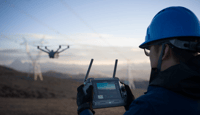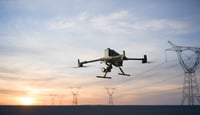

For enterprise drone operators working in Europe and the UK, the most significant barrier to scaling operations isn't payload capacity or flight time, it's airspace access. Standard Scenarios STS-01 and STS-02 unlock flights over populated urban areas and Beyond Visual Line of Sight operations, respectively, but qualifying for them requires the aircraft to meet specific safety-class requirements that most platforms don't meet out of the box.
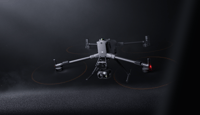
DJI AP100 Parachute is purpose-built to close that gap. Designed specifically for the Matrice 400, it integrates an independent flight control system, dual-redundant power, and a sub-600 ms Flight Termination System into a rear-mounted package that preserves the aircraft's full operational envelope, from battery swaps to payload flexibility to carrying-case compatibility.
When mounted, Matrice 400 meets the European Union Aviation Safety Agency's C5/C6 requirements and the UK Civil Aviation Authority's UK5/UK6 requirements.[2] That means access to STS-01 and STS-02 operations, and the expanded commercial footprint they enable, without a bespoke aircraft or a separate platform investment.
European Standards for Compliant Flights
C5/UK5 and C6/UK6 Compliance
Paired with DJI AP100 Parachute, Matrice 400 satisfies EASA's C5 and C6 class requirements and the UK CAA's UK5 and UK6 requirements.[2] This enables operators to fly under Standard Scenarios without needing individual operational authorization from their national aviation authority; a declaration to the relevant NAA is sufficient.
- STS-01 (C5/UK5): Visual Line of Sight operations over controlled ground areas in populated environments
- STS-02 (C6/UK6): Beyond Visual Line of Sight operations with Airspace Observers over controlled ground areas[5]
Safety Self-Check, Dual Redundant System
Continuous Self-Diagnostics
From the moment Matrice 400 powers on and throughout every flight, the AP100 continuously monitors the status of its gas generator and communication links. If an anomaly is detected, real-time alerts appear via the Health Management System (HMS) in DJI Pilot 2, giving operators an immediate, actionable view of system health before and during missions.
Intelligent Algorithms, Redundancy Validation
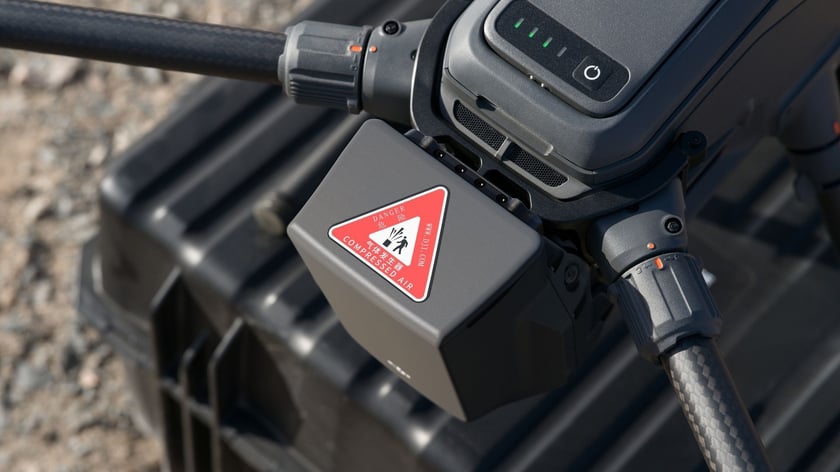
The AP100 operates as a self-contained safety module with its own independent flight control system and onboard sensors, including an IMU. Intelligent algorithms continuously cross-validate parachute and drone data in real time, significantly reducing the risk of accidental deployment due to false positives.
Independent Power
Built-in dual capacitors provide up to 1 hour of independent backup power.[6] This ensures uninterrupted flight attitude monitoring and automatic deployment capability, entirely independent of main aircraft power or an active E-Port connection.
Instant Motor Cut-Off
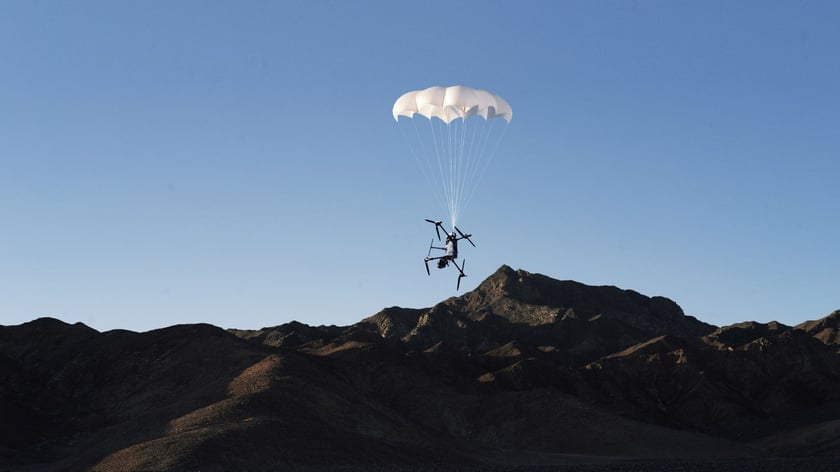
When deployment is triggered, an independent Flight Termination System (FTS) cuts motor power within 600 ms,[3] halting rotor rotation before parachute ejection. Stopping the rotors first prevents entanglement with the canopy, a critical design consideration for reliable deployment at operational altitudes.
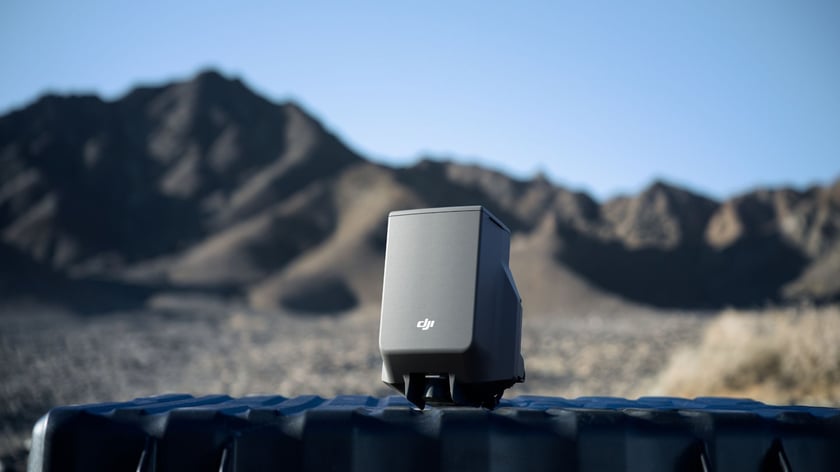
Audio and Visual Alarms
After deployment, the system emits continuous loud alarms and high-intensity flashing lights for approximately 1 hour.[6] This serves two functions: warning bystanders on the ground to clear the landing zone, and helping operators quickly locate and recover equipment.
Fast Deployment, Reduced Impact
|
Metric |
Value |
|---|---|
|
Automatic Deployment Response Time |
≤ 600 ms |
|
Deployment Altitude ≥ 30 m |
The parachute will eject |
|
Deployment Altitude < 30 m |
The parachute will eject |
|
Aircraft has not taken off |
The parachute will not deploy |
Automatic Deployment
The parachute automatically deploys when the aircraft detects abnormal flight attitude or speed anomalies[7]. In the EU, UK, and other supported countries or regions, it will also trigger when the drone breaches a Geocaging[8] boundary set in DJI Pilot 2.
However, to mitigate the risk of damage to nearby equipment or property caused by close-range deployment, automatic deployment will be disabled under either of the following conditions:
1. The aircraft is within a 10m radius of the Home Point, and its relative altitude is within 15 m above or below the Home Point.
2. With Cleaning Mode enabled, the aircraft is within a 10m radius of the Home Point, and its relative altitude is within 15 m above the Home Point.
Manual Deployment
Operators can trigger deployment manually via an on-screen slider in DJI Pilot 2. In the EU, the UK, and other supported countries or regions, remote deployment is also available through DJI FlightHub 2's Flight Termination System (FTS) page[9] using the aircraft serial number and a verification code, which requires a DJI Cellular Dongle 2[10] and an active 4G connection.
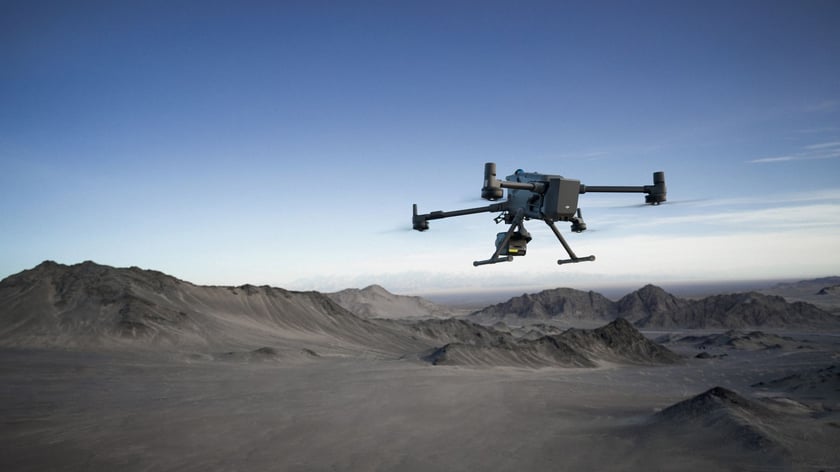
Lightweight, Fits Drone Case
Lightweight Design
At approximately 935 g, the AP100 preserves Matrice 400's 15.8 kg maximum takeoff weight. The flight-time impact is approximately 6 minutes [11], a minimal trade-off for the operational access it enables.
Easy Storage
The rear-mounted design avoids any interference with battery swaps or payload configurations. Matrice 400 fits directly into its standard carrying case with the parachute attached, eliminating the need to remove and reinstall the system between missions and reducing setup time in the field.
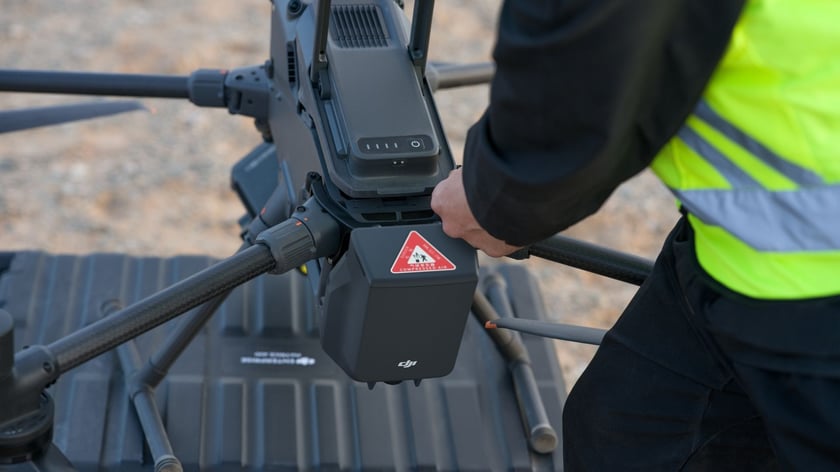
Built for Harsh Environments
IP55 All-Weather Rating
Sharing Matrice 400's IP55 rating,[12] the AP100 operates reliably in challenging conditions including heavy dust and rain. The system maintains stable performance across temperatures from -20° to 50° C (-4° to 122° F), delivering consistent results in both cold northern European winters and hot summer operations.
Get Started with DJI AP100 Parachute
DJI AP100 Parachute is a focused, well-engineered answer to one of the most pressing operational challenges for enterprise drone programs in Europe and the UK: gaining access to restricted urban airspace without acquiring a dedicated aircraft.
By integrating an independent flight control system, dual-capacitor backup power, and a sub-600 ms FTS into a rear-mounted module that leaves the Matrice 400's carrying case, battery access, and payload flexibility intact, the AP100 adds compliance capability without operational compromise.
For operators targeting STS-01 flights over populated areas, mounting AP100 to an existing Matrice 400 is the direct path to C5/UK5 qualification. For programs requiring STS-02 BVLOS capability, the Matrice 400 (C6) Worry-Free Plus Combo provides the factory-certified C6/UK6 route.
Both routes provide access to the same expanded operational envelope: structured urban operations, denser flight corridors, and the longer-term program scalability that reliable airspace access enables.
To learn more or arrange a product demonstration, contact your local DJI Enterprise dealer.
Disclaimers
[1] DJI AP100 Parachute is designed for use with the DJI Matrice 400. To ensure unobstructed parachute deployment and prevent false obstacle-sensing triggers, the Matrice 400 will automatically disable its downward and backward mmWave radars once the AP100 is mounted. The drone's ability to sense small obstacles in these directions will be limited. Pay attention to the flight environment and manually avoid obstacles to ensure flight safety. The mmWave radar function may be unavailable or restricted in some countries or regions. Refer to local laws and regulations for more information.
[2] Mounting the DJI AP100 Parachute on an existing Matrice 400 meets C5 or UK5 operational safety requirements (applicable for STS-01). To meet C6 or UK6 requirements (as applicable to STS-02), users must purchase the DJI Matrice 400 (C6) Worry-Free Plus Combo. Under applicable regulations, the C6 or UK6 Class label applies only to factory-certified systems and cannot be obtained by mounting a parachute onto an existing aircraft.
[3] Measured in a controlled laboratory environment. With DJI Matrice 400 hovering and propellers spinning, this is the total time interval from the triggering of the FTS signal, through confirmation of a complete rotor stop, to the triggering of the gas generator's electrical signal. Data is for reference only. Actual results may vary depending on environment, usage, and firmware version.
[4] Measured in a windless environment at 25° C (77° F), at an altitude between 30 m and 500 m, with DJI Matrice 400 at its maximum takeoff weight of 15.8 kg. Data is for reference only. Actual results may vary depending on environment, usage, and firmware version.
[5] According to EASA regulations, the European Standard Scenario (STS) is a predefined operation. An operator is not required to obtain an operational authorization for an STS operation; submitting a declaration to the NAA of the state of registration is sufficient. STS-01 (C5) applies to VLOS operations over a controlled ground area in a populated environment. STS-02 (C6) applies to BVLOS operations with Airspace Observers over a controlled ground area. For full details, refer to the official EASA website.
[6] Measured at 25° C (77° F) with the parachute in its factory state, or when connected to the aircraft for over 30 minutes of flight time each month. Data is for reference only. Actual results may vary depending on environment, usage, and firmware version.
[7] (a) The minimum effective deployment altitude is 30 m, the minimum vertical altitude required for the parachute to stabilize the aircraft's descent below 5 m/s. If deployed below 30 m, the parachute will still eject but may not fully inflate to adequately slow the descent. The parachute will not deploy until the aircraft has taken off. (b) The 30 m data were measured in a windless environment at 25° C (77° F) and an altitude below 500 m, using a Matrice 400 at its maximum takeoff weight of 15.8 kg. Data is for reference only. (c) Automatic deployment is disabled under either of the following conditions: (i) the aircraft is within a 10 m radius of the Home Point and its relative altitude is within 15 m above or below the Home Point; (ii) with Cleaning Mode enabled, the aircraft is within a 10 m radius of the Home Point and its relative altitude is within 15 m above the Home Point.
[8] Geocaging is supported in the following countries and regions: EU member states (Austria, Belgium, Bulgaria, Croatia, Cyprus, Czechia, Denmark, Estonia, Finland, France, Germany, Greece, Hungary, Ireland, Italy, Latvia, Lithuania, Luxembourg, Malta, Netherlands, Poland, Portugal, Romania, Slovakia, Slovenia, Spain, Sweden), the United Kingdom, Norway, Iceland, Switzerland, Liechtenstein, Serbia, and Georgia.
[9] FTS Deployment via DJI FlightHub 2 is supported in the same countries and regions as Geocaging (see [8] above). FTS interface: https://fh.dji.com/fts/index.html#/
[10] The DJI Matrice 400 supports the installation of two DJI Cellular Dongle units. If only one dongle is used, install it in the 4G-1 compartment to ensure normal 4G functionality. The 4G Enhanced Transmission service is not available in certain countries or regions. Consult your local dealer for details.
[11] Measured with the aircraft flying forward at a constant speed of 10 m/s in a windless environment at sea level, carrying the H30T and AP100 Parachute (total weight 11,605 g), until forced landing due to battery depletion. Data is for reference only. Actual results may vary depending on environment, usage, and firmware version.
[12] Please follow the requirements stated in the IP55 protection rating instructions. Measured in a controlled environment. The IP rating is not permanently effective and may decrease due to product wear and tear.
[13] The parachute is a single-use safety device and must be replaced once deployed. If the product passes daily self-checks and remains undeployed after activation, it requires no factory maintenance for 3 years. To ensure system effectiveness and flight safety, it is recommended to discontinue use of the product 3 years after activation. For warranty details, visit: https://www.dji.com/service/policy.
Always comply with local drone laws and regulations when operating. Contact an authorized DJI dealer or DJI After-Sales Support if you experience any issues with your equipment or software.