
The first questions a serious evaluation of any police or security drone program asks are not about flight time or camera resolution. They are about data. Where does the footage go? Who can see it? How long is it kept, and who is accountable for it? An IT security reviewer asks these questions before approving anything, and a community asks them before trusting anything. A Drone as First Responder program has to answer both.
This article walks through those answers directly: where DFR data can be stored and who controls it, how it is protected, and how a program handles privacy in a way that a community can actually trust. It is written for the people who have to make the call, whether that is a security reviewer signing off on a deployment or a resident who wants to know what the drone overhead is doing.
One shift changes the data question, so it belongs up front. Early drone response put a pilot in the field with a drone. The model that scales is the one where the drone already lives at the scene in a dock and launches on its own, which is what Dock as First Responder means. When the drone becomes a permanent, always-connected part of the response system, where its data lives and who can reach it stops being a detail and becomes the foundation of the whole program.
Where Is Police Drone Footage Stored?
This is usually the first hard question, and the honest answer is that it depends on how the program is deployed. There is no single place all DFR data goes. Instead, the program is set up in one of three ways, and that choice determines where the data physically sits and who controls it.
Managed cloud. The data runs in the drone platform's managed cloud service, hosted in regional data centers. This is the fastest way to get a program running, because there is no local infrastructure to build. The provider handles the platform, the security updates, and the cloud-side controls, while the operating organization manages its own accounts, permissions, and data-retention rules. For a program that wants to validate the model quickly, this is often the starting point.
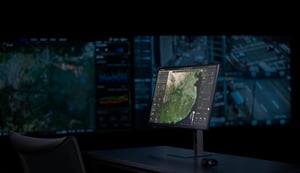
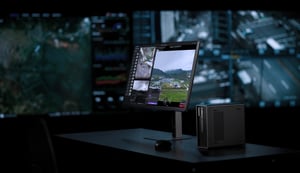
On-site appliance. The platform runs on a pre-integrated unit inside an environment the operating organization controls. This gives stronger local control than managed cloud without the full complexity of building a private deployment from scratch. It is a middle path for teams that want their data closer to home but do not need, or are not ready for, a fully self-hosted system.
On-premises (self-hosted). The platform is deployed inside the operating organization's own network, on its own servers or its own designated environment. Data storage and processing can stay entirely within local or specified infrastructure. This is the option built for organizations with the strictest control requirements, and it is the one that matters most to law enforcement, which is why it deserves a closer look.
The reason this choice matters so much is that it defines the data-control boundary. The more control an organization needs over where its data sits and who can touch it, the further along that scale it moves, from managed cloud, to an on-site appliance, to fully self-hosted. The trade is usually control against convenience: the most self-contained option also asks the most of the organization running it, which brings us to the responsibility question later in this article.
On-Premises Drone Data Storage: Why It Matters for Law Enforcement
For a police department, the data question often is the whole question. Law-enforcement data carries audit requirements and access rules that a general commercial deployment does not, and the ability to keep that data under local control is frequently what makes a program approvable at all.
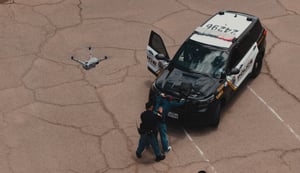
This is the practical value of the on-premises option, and a real program shows why. El Paso runs a citywide DFR program, and it uses on-premises deployment specifically so it can keep data under local control and meet the audit requirements that apply to law enforcement. Because the data can stay within the department's own environment, the command center can run the program while satisfying the data-handling and auditability standards its oversight requires. The deployment choice is not a technical footnote in that program. It is what lets the program exist within the rules the department operates under.
The general principle underneath the El Paso example is simple. When an organization has hard requirements about data residency and access, the deployment model has to meet those requirements rather than work around them. On-premises exists for exactly that reason.
Who Can Access Drone Footage, and How Is It Protected?
Storage location answers where the data sits. The next question is who can reach it and how it is guarded along the way. A DFR program handles this through several layers, and the useful thing for a non-technical reader is the shape of the protection rather than the mechanics.
Data is encrypted in transit. The links carrying video, location, and control data between the aircraft, the dock, and the platform are encrypted, which protects them from interception and tampering. This is a baseline, not a feature.
Access is controlled by role. Not everyone in a program can see everything. Command center operators, pilots, device administrators, evidence administrators, and IT administrators are each authorized for what their role actually requires, and third-party systems are scoped the same way. The principle is least access: people and systems get the minimum visibility they need to do their job, not blanket access to the whole program.
Every action leaves a record. A DFR program keeps audit logs of what happened and who did it: which missions ran, who operated them, how files synced, and how the system behaved. That record is what makes accountability possible after the fact. When someone asks who viewed a piece of footage or who downloaded a file, the answer is not a matter of memory. It is in the log.
The platform is independently certified. The drone platform holds ISO 27001 certification, an international standard for information security management, issued after independent audit. That matters as third-party evidence that the security management practices behind the platform are real and reviewed. One caveat belongs here, and stating it is a matter of being accurate rather than modest: ISO 27001 certification does not automatically satisfy an organization's own legal obligations. Requirements like GDPR or local law-enforcement data rules vary by country and region and have to be assessed separately. The certification is evidence of sound practice, not a substitute for a program's own compliance review.
For readers who need the full technical picture, the encryption methods, the identity and access mechanisms, the storage protections, and the certification details are all documented in the Dock as First Responder whitepaper. The point here is the structure: encrypted movement, role-based access, a complete audit trail, and independent certification, with an organization's own legal review sitting on top.
How DFR Programs Protect Privacy in Practice
Security controls answer how the data is protected. Privacy is a different question: not whether the data is safe from outsiders, but whether the program collects and uses it in a way the community finds legitimate. Encryption does nothing for that question. Privacy is governed by how the program is run, and a well-governed program applies a few clear principles.
Purpose limitation. The program operates around defined event types. It responds to specific triggers and incidents, rather than becoming open-ended, always-on monitoring. This is the single most important line in privacy governance: a DFR program is a response tool, not persistent surveillance, and the way it is configured should enforce that distinction rather than just assert it.
Area limitation. Flights are bounded to relevant operating areas. No-fly zones keep drones away from sensitive locations, and defined task and flight areas keep missions on incident-relevant airspace rather than roaming. The drone goes where an incident calls it, not everywhere.
Least access. The same role-based principle that protects the data also governs who can use the program day to day, so that access to footage and control of the drone are limited to the people whose role requires them.
Retention with rules. Not all footage is kept the same way. Event-related media, routine recordings, report materials, and anything under legal hold are handled under different retention rules, so data is not simply stored forever by default. How long something is kept should follow a policy, not inertia.
Transparency. A public-safety program can explain, publicly, what it does: the purpose of the program, how data is used, and what oversight applies. This is where privacy governance meets community trust, and it is the part a program cannot handle purely with technology.
It is also worth being honest about the limits of the tool itself, because a trustworthy program does not oversell. Weather and airspace restrictions constrain when and where a drone can fly. A DFR program is bounded by real operational limits, and acknowledging them is part of describing it accurately.
Why Trust Is an Operating Capability, Not a Message
Community trust is easy to mistake for a communications exercise, something handled with a press release after the program is already built. That has it backward. For a DFR program, trust is not a message laid over the top. It is a property of how the program is actually designed and run.
Every element in this article contributes to it. The deployment choice determines who controls the data. The access controls determine who can reach it. The audit trail makes accountability real rather than promised. The privacy governance keeps the program inside its defined purpose. And transparency lets the community see that these things are true rather than take them on faith. A program that gets the governance right and explains it plainly earns a kind of trust that no amount of messaging can manufacture, and a program that gets it wrong cannot message its way out.
This is also why the human role stays central. A DFR program keeps people in the loop by design: a pilot supervises each flight remotely and can take manual control at any time, and a command center makes the decisions about how to respond. Automation handles the routine, and people remain accountable for the judgment. That accountability is part of what makes a program trustworthy, and it does not get automated away.
None of this is a reason to treat data security and privacy as obstacles to clear before the real work begins. They are the real work. A DFR program that handles them well is not just compliant. It is one a community can live with over the long run, which is the only kind of program worth building.
New to the model? Start with our overview: Drone as First Responder (DFR): How Docks Are Changing the Model. You can also read the full technical detail on data handling in the Dock as First Responder whitepaper, and see DJI's approach to enterprise data security at enterprise.dji.com/data-security.
Download the Dock as First Responder whitepaper → · DJI Enterprise data security →